

Klondike Solitaire is more than just a digital time-passer; it’s a classic game of patience and strategy with a rich history dating back centuries. Known simply as “Patience” in Europe, the name “Klondike” is a nod to the gold rush miners of the 1890s who played it to pass the time.
Whether you’re looking for a quick mental break or a challenging puzzle, this guide will walk you through everything you need to know—from basic rules to winning strategies for popular variations like Klondike Solitaire Turn 3.
The Basics: Game Layout and Objective
Before you make your first move, it’s helpful to understand the playing field. A game of standard Klondike Solitaire uses one 52-card deck and consists of three main areas:
- The Tableau: This is the main playing area, consisting of seven columns arranged in a staircase pattern. The first column has 1 card, the second has 2, and so on, up to 7 cards in the last column. Only the bottom card in each column is face-up at the start.
- The Foundation: These are the four empty spaces at the top. Your ultimate goal is to move all cards here, building each pile in ascending order (Ace to King) by suit.
- The Stock & Waste Piles: The remaining cards form the face-down stock pile. You draw cards from here into a waste pile, and the top card of the waste pile is always available to play.
Your objective is straightforward: move all 52 cards from the tableau and stock pile into the four foundation piles.
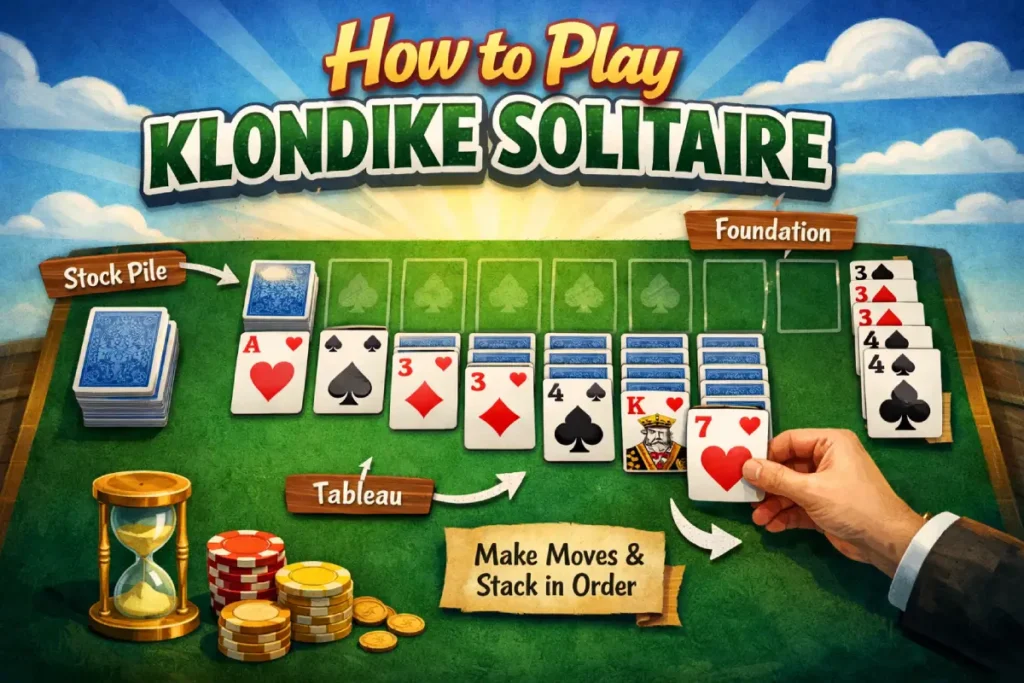
How to Play Klondike Solitaire and Make Moves
The game progresses by moving cards between the tableau, waste pile, and foundations according to specific rules.
- Building the Tableau: You can build cards on the tableau in descending order (King to Ace), alternating between red and black suits. For example, you can place a black 8 on a red 9. You can move a single card or a sequenced group of cards as a stack.
- Uncovering Cards: When you move a face-up card off a column, the card beneath it is flipped face-up and becomes playable. This is one of the most critical actions in the game.
- Using the Stock: Click the stock pile to draw cards. Depending on your game mode, you will draw one card (Turn 1) or three cards (Turn 3) at a time. Only the topmost card in the waste pile is playable.
- Building Foundations: When an Ace becomes available, you can move it to start a foundation pile. You can then place the 2, 3, 4, and so on of that same suit on top. Cards can be moved to the foundation directly from the tableau or the waste pile.
- The King Rule: An empty column in the tableau can only be filled with a King (or a valid sequence starting with a King).
Winning Strategies and Pro Tips
While luck plays a role, smart strategy dramatically increases your odds of winning.
- Prioritize Revealing Face-Down Cards: Your top priority should always be to uncover hidden cards in the tableau. Focus on moves that free up the face-down cards in the largest columns first.
- Build Foundations Wisely: Move Aces (and sometimes 2s) to the foundations early to clear the tableau. However, try to build all foundations at a relatively even pace. If one suit gets too far ahead, you may run out of the alternating colors you need for sequencing.
- Think Before Emptying a Column: A powerful move is to clear an entire tableau column, as it gives you a free space to maneuver Kings. However, only empty a column when you have a King ready to place there. An empty column that can’t be filled can actually limit your options.
- Plan Your Stock Draws: Especially in Turn 3 games, think ahead. Playing a card from the waste pile changes which card will be available next. Sometimes, delaying a move can unlock a more important card.
Popular Variations: Double Klondike and Turn 3
Once you’ve mastered the basics, these variations offer fresh challenges.
- Klondike Solitaire Turn 3: This is the more challenging classic version. Instead of drawing one card from the stock, you draw three at a time, and only the top one is playable. This buries cards deeper, requiring more strategic planning. Statistically, it’s much harder, with a win rate of about 11.1% compared to Turn 1’s 33%.
- Double Klondike Solitaire: For a longer, more complex game, try Double Klondike. It uses two decks (104 cards total) and features a larger tableau of nine columns and eight foundation piles (two per suit). Interestingly, the extra cards provide more options, making it statistically easier to win (about a 54.5% win rate) than single-deck Klondike, though games take longer.
Where to Play Free Klondike Solitaire Online
You don’t need a physical deck of cards to enjoy this classic. Many great websites offer free Klondike Solitaire online with no download or registration required. These platforms often include features like hints, undo buttons, and daily challenges to enhance your experience.
Ready to play? You can practice your strategy right now by playing a game of free Klondike Solitaire at Solitrd.
Frequently Asked Questions: Klondike Solitaire
1. What is the difference between Klondike Solitaire Turn 1 and Turn 3?
The core difference is how many cards you draw from the stock pile. In Klondike Solitaire Turn 1, you draw one card at a time, making all cards accessible more quickly. Klondike Solitaire Turn 3 is the more traditional and challenging version where you draw three cards at once, and only the top card is playable. This “Turn 3” rule significantly increases the difficulty and requires more forward planning.
2. Can I play free Klondike Solitaire online without downloading anything?
Absolutely. Many websites offer free Klondike Solitaire online that runs directly in your web browser—no app installation or download is required. These sites are perfect for a quick game on your computer, tablet, or phone.
3. What is Double Klondike Solitaire?
Double Klondike Solitaire is a popular variation that uses two standard decks (104 cards). The game has a larger tableau of nine columns, and the goal is to build eight foundation piles (two for each suit). While it involves more cards, the increased options can sometimes make it easier to win than the single-deck version.
4. Is Klondike Solitaire a game of luck or skill?
It’s a blend of both. The initial deal is random (luck), but skilled players make strategic decisions that greatly increase their win rate. Knowing when to move cards to the foundation, how to sequence moves to uncover hidden cards, and how to manage empty columns are all crucial skills.
5. What are the official rules for winning Klondike Solitaire?
You win a game of Klondike Solitaire when all 52 cards are moved from the tableau and stock pile onto the four foundation piles. Each foundation must be built in ascending order (Ace, 2, 3… up to King) and all cards in a single pile must be of the same suit.
6. Why can I only move a King to an empty column in the tableau?
This is a fundamental rule that maintains the game’s structure. Since sequences on the tableau are built in descending order (King to Ace), only a King—the highest-value card—can logically start a new sequence in an empty space. This rule adds a key strategic layer to the game.
7. What’s a good strategy for beginners playing free Klondike Solitaire?
Focus first on revealing face-down cards in the tableau. Try to build longer alternating-color sequences, and avoid moving cards to the foundation too early if they could be useful for building tableau sequences. Many free Klondike Solitaire sites offer “Hint” or “Undo” features to help you learn.
8. How do I get better at the harder Turn 3 version?
For Klondike Solitaire Turn 3, patience and planning are key. Pay close attention to the order of cards in the waste pile, as playing a top card will reveal the one beneath it. Try to cycle through the stock pile methodically to find the cards you need to unlock stalled columns.
9. Are there different difficulty levels in online Klondike Solitaire?
Yes, online versions often let you choose. The main difficulty settings are “Draw 1” (easier, higher win rate) and “Draw 3” (standard, more challenging). Some sites also offer “Vegas” scoring or timed modes for an extra challenge.
10. If I get stuck, can I replay the same game?
On most free Klondike Solitaire online platforms, each game is generated randomly. If you get stuck and lose, you’ll start a brand-new game. However, many sites do offer an “Undo” button to take back your last move, which is a great learning tool.
Conclusion: Find Your Perfect Solitaire Challenge
Ready to master Klondike Solitaire? Now you know the essential rules, winning strategies, and how to tackle variations like the challenging Klondike Solitaire Turn 3 and the longer Double Klondike Solitaire.
The best way to improve is to play. You can practice all your new skills right away with a game of free Klondike Solitaire online at solitrd.com.
Deal the cards and enjoy the classic game!
